



Squirting has more porn-inflected misconceptions attached to it than almost any other sexual topic. This is the honest UK version: what it actually is, why it happens (or doesn't), and the technique that increases the likelihood for bodies that do squirt. Written for vulva-owning bodies on the receiving side; the giving side works the same whether solo or partnered.
What squirting actually is
Squirting is the involuntary expulsion of fluid from the urethra during high sexual arousal. The fluid originates from Skene's gland (sometimes called the female prostate or the paraurethral gland), a small organ adjacent to the urethra that is the embryological homologue of the male prostate.
The fluid is mostly water with small amounts of glucose, prostatic-specific antigen (PSA), and creatinine; testing has consistently shown it is biochemically distinct from urine, though some urethral involvement during the expulsion means a small amount of trace urine may be present. It is not the same as the natural vaginal lubrication produced during arousal, which is a separate physiological process.
Not all vulva-owning bodies squirt. A 2013 study (Salama et al., Journal of Sexual Medicine) estimated 10-54% of women have experienced squirting, with wide variation by definition and self-report method. The honest reading: it's not rare, but it's not universal, and there is no body-shape, anatomical, or technique factor that predicts who can.
What it isn't
The porn misconceptions, addressed:
It is not a fountain. Real squirting is usually a small expulsion (a tablespoon to a few tablespoons), not the staged volumes shown in porn. When porn shows large volumes, those are typically faked with prior bladder-fill or external water sources. Don't compare your experience to a performance.
It is not the same as orgasm. Squirting can happen before, during, or after orgasm, or completely separately from it. Some people squirt routinely without orgasm; others orgasm without squirting; others have both. They are distinct physiological events.
It is not a goal. Treating squirting as a target turns a relaxation-dependent body response into a performance-dependent one. The cruel irony: trying to squirt is the surest way to not squirt. Bodies that respond to G-spot stimulation produce squirting when they're relaxed enough; bodies that aren't relaxed don't.
It is not pee, but it might involve some urine. The biochemical distinction is real, but the urethra is the urethra. Empty your bladder before the session; this prevents the "is it pee?" anxiety from interfering with relaxation.
A note on Skene's gland anatomy
Skene's gland sits adjacent to the urethra, with ducts opening near the urethral meatus. It is generally believed to be the structure responsible for both female ejaculation (the smaller, milky fluid associated with orgasm) and squirting (the larger, clearer expulsion). The two are sometimes presented as the same thing and sometimes as distinct phenomena; the current scientific consensus is that they are related but not identical.
The G-spot, an area on the anterior vaginal wall roughly 5-7 cm inside, is thought to be the surface manifestation of Skene's gland and the surrounding tissue. Direct firm pressure on this area is what triggers Skene's gland activity in bodies that squirt.
The technique that increases likelihood
For bodies that do squirt, the technique is reasonably consistent. Five elements:
1. Empty the bladder first. Both for biological reasons (less actual urine in the picture) and psychological ones (the "I think I need to pee" sensation immediately before squirting is the body's signal, not a problem; not worrying about it makes it easier to follow through).
2. Genuine arousal first. Squirting almost never happens cold. Plan for 20-30 minutes of warm-up, ideally including an orgasm or near-orgasm before the squirting-focused stimulation begins. The body needs to be in a high-arousal state for Skene's gland to be primed.
3. Firm rhythmic G-spot pressure. Find the G-spot (the slightly rougher patch on the anterior vaginal wall, about 5-7 cm in). Apply firm, rhythmic pressure with a "come hither" finger motion or with a curved G-spot toy. The G-spot wants pressure, not friction; the technique is rhythmic squeezing rather than rubbing.
4. Bear down rather than tense up. When the urgent "I might pee" sensation arrives, the instinct is to clench. Do the opposite: bear down gently as if releasing the bladder. This is the actively counter-instinctive part; bodies that learn to do this experience squirting reliably, bodies that clench don't. Practice the bear-down feeling outside sex first if it helps.
5. Continue stimulation through the expulsion. Squirting often happens in pulses rather than as a single release. If the first pulse comes, maintain the rhythmic pressure rather than withdrawing; subsequent pulses often follow.
Positions that help
Bodies that squirt usually do so most easily in positions where the G-spot is accessible to firm direct pressure:
- Lying on back, partner kneeling between thighs: the giver has both hands free and can apply consistent firm pressure with two curled fingers. The standard solo-partnered position for G-spot exploration.
- Doggy style with G-spot toy: the natural angle of the vaginal canal in this position aligns well with a curved G-spot toy. The receiver controls depth and angle.
- Solo, lying on back with knees bent: easiest position for self-discovery; a curved toy reaches the G-spot reliably with the receiver in full control of pressure and rhythm.
Positions that work less well for first-time exploration: standing positions (gravity works against the relaxation required), face-to-face penetration (the angle doesn't reliably hit the G-spot), anything requiring complex coordination.
Toy recommendations
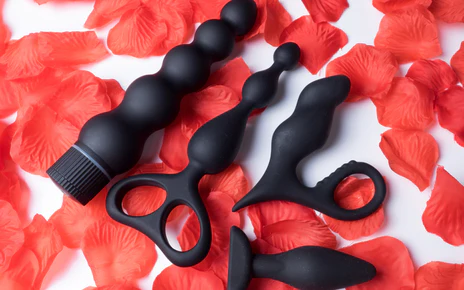
A curved G-spot vibrator is the single most useful tool for self-exploration. The curve aligns with the vaginal canal to reach the anterior wall, and the firm pressure of a rigid or semi-rigid toy is often more effective than fingers (which fatigue and lose pressure consistency over the 10-20 minutes the technique often takes).
For UK first-time buyers: a £50-£100 platinum-silicone G-spot vibrator (Lelo Gigi 2, We-Vibe Rave, similar) is the sweet spot. Avoid soft floppy toys (they can't apply consistent firm pressure) and overly long ones (G-spot work is shallow, not deep). Pair with water-based lubricant.
The G-spot vibrators buyer's guide covers the options in more detail.
Practical considerations
The mess is real. Even small squirting events produce visible fluid on bedding. Practical steps:
- Old towel or bath towel under the receiver. Best practical move. Mattress protectors work; absorbent picnic blankets work; a folded duvet cover works.
- Sex on bathroom tile or in the shower sidesteps the laundry question entirely, at the cost of comfort.
- Squirting blankets (waterproof-backed throws marketed for this) exist; they're functional but not essential. A regular towel does the same job.
- Wash bedding promptly. If anything does get on the sheets, cold wash before heat; heat sets organic stains.
What to do if it doesn't happen
Most likely outcome on a first attempt: it doesn't. This is normal. A few common reasons:
- Not relaxed enough. Squirting is a release response, and stress prevents it. Try again on a different night, in a less goal-oriented frame.
- Clenched at the moment. The bear-down counter-instinct is hard to learn. Practice it outside sex first.
- Your body doesn't squirt. A real outcome and not a failure. Plenty of bodies don't, and excellent sex doesn't require it.
- The stimulation wasn't right. Different bodies want different pressures, angles, and rhythms. A curved toy with adjustable intensity often finds the right combination faster than fingers.
The framing matters more than the technique. Bodies that approach squirting as an interesting possibility produce it more often than bodies that approach it as a target. If it doesn't happen, the session wasn't a failure; if it does, it wasn't a triumph.
When to see a GP
Squirting is not medically harmful. But if you experience any of the following alongside squirting attempts, the GP conversation is worth having:
- Pain during G-spot stimulation that persists after the session.
- Blood in the expelled fluid.
- A persistent feeling of urinary urgency after sessions.
- Any change to your usual continence pattern.
These are uncommon but worth ruling out a urinary tract issue or pelvic-floor concern that's unrelated to the squirting itself.
- Can every woman squirt?
- No. Estimates range from 10-54% of vulva-owning bodies experiencing squirting at some point (Salama et al., 2013), and there is no anatomical or technique factor that predicts who can. Bodies that don't squirt are completely normal; bodies that do are also normal.
- Is squirting just pee?
- No. The fluid is biochemically distinct from urine, originating from Skene's gland (the female prostate). However, because the urethra is involved in the expulsion, small amounts of trace urine may be present. Emptying the bladder beforehand reduces this entirely.
- How can I learn to squirt?
- The technique: genuine arousal first, firm rhythmic pressure on the G-spot (the anterior vaginal wall, 5-7 cm in), and bearing down rather than clenching when the urgent sensation arrives. A curved G-spot vibrator usually reaches the right area more reliably than fingers. Most bodies that can squirt take several attempts to learn the bear-down counter-instinct.
- Is squirting the same as orgasm?
- No. They are distinct events that can happen together, separately, or not at all. Some bodies squirt without orgasm; others orgasm without squirting; others have both. They share some physiological pathways but are not identical.
- Why does it feel like I need to pee?
- Skene's gland sits adjacent to the urethra, so when it fills with fluid (the lead-up to squirting), it produces a sensation very similar to bladder fullness. The counter-instinct of bearing down rather than clenching is what allows the squirting expulsion to happen. Empty your bladder before the session and the sensation becomes easier to trust.
- What\'s the best toy for learning to squirt?
- A curved G-spot vibrator in platinum silicone, firm rather than floppy, around £50-£100 for a quality first piece. Lelo Gigi 2 and We-Vibe Rave are the most-recommended for this. Pair with water-based lubricant; silicone-based lubricant degrades silicone toys.
Sources and further reading
- Salama, S., et al. (2015). Nature and Origin of "Squirting" in Female Sexuality. Journal of Sexual Medicine, 12(3), 661-666.
- Whipple, B., & Komisaruk, B. R. (1988). Analgesia produced in women by genital self-stimulation. Journal of Sex Research, 24, 130-140.
- Foldès, P., & Buisson, O. (2009). The clitoral complex: a dynamic sonographic study. Journal of Sexual Medicine, 6(5), 1223-1231.
- NHS sexual health overview
- Brook (UK sexual health charity)
Filed under Techniques
← Back to the Guides

