



Latex as everyday wear is a real thing some people do, but the honest version is narrower than the fantasy. Nobody is wearing a full latex catsuit to a Tuesday meeting. What "latex for the office" actually means in practice is a discreet latex piece worn under ordinary clothes, briefs, a vest, shorts, something close to the body and invisible beneath a normal outfit, kept as a private thing the wearer knows about and nobody else does. The appeal is exactly that: a secret layer, the feel of latex against the skin through an unremarkable day. The practical facts that decide whether it works: latex does not breathe, so heat builds and a full day is ambitious, half a day is realistic; dressing takes time and a dressing aid, so it is a plan, not a spontaneous thing; and thin, simple pieces work, structured or thick ones do not under clothes. This guide is the realistic version of the idea, what works, what does not, and the facts behind both.
Latex everyday wear, latex under clothes, discreet latex
"Latex everyday wear", "wearing latex under clothes" and "discreet latex" all describe the same practice: wearing a latex piece in ordinary daily life rather than as fetish-scene clothing. The realistic form of it is a hidden layer, not a visible outfit.
The honest reality
The fantasy of latex everyday wear is a striking visible outfit. The reality, for almost everyone who actually does it, is a discreet piece worn invisibly under normal clothes. That is not a lesser version, it is the point: the appeal is the private knowledge of it, the feel of the material against the skin through a day where nobody around you knows. A latex brief or vest under a work shirt and trousers is the genuine article. A latex catsuit at the office is not a thing that happens, and a guide that pretended otherwise would not be useful.
What works under clothes
| Piece | Works under clothes? | Why |
|---|---|---|
| Latex briefs / shorts | Yes | Thin, close to the body, invisible under trousers or a skirt |
| Latex vest / thin top | Yes, with care | Works under a looser shirt; visible seams under fitted tops |
| Latex stockings | Sometimes | Can pass under trousers; the sheen may show with a skirt |
| Structured pieces (corsets, etc.) | No | Bulk and shape show through clothing |
| Thick (0.6mm+) latex | No | Too stiff and warm for a discreet layer |
| Catsuits, dresses | No | These are outfits, not layers |
The rule: thin, simple, close to the body works as a hidden layer. Structured, thick or shaped does not. Entry-weight latex (around 0.4mm) is the right thickness for this, supple enough to disappear under clothes.
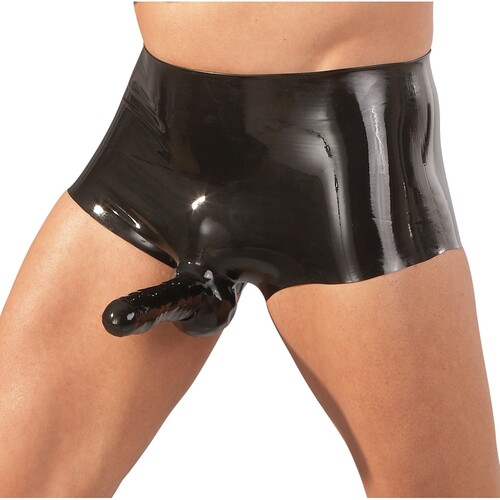
Latex Boxers
A thin latex piece that works as a discreet under-layer. ~£50.
£49.99 →The heat fact
The single biggest practical limit: latex does not breathe. It traps heat and moisture against the skin, which is part of the sensation but also the constraint. A full working day in a latex piece is ambitious, most people who do this find half a day is the realistic ceiling, and a cool environment helps a great deal. Plan around it: a latex layer for a morning of meetings, not a twelve-hour day; an air-conditioned office, not a heatwave. Treating the heat as a known limit rather than fighting it is what makes the practice sustainable.
The dressing-time fact
Latex grips dry skin, so getting into it needs a dressing aid, talc or a silicone-based dressing lubricant, and time. This makes office latex a plan, not a spontaneous decision: it is something you dress into deliberately before leaving the house, with five to ten unhurried minutes, not something you can decide on at your desk. Build the dressing time into the morning, and accept that it is part of the ritual.
Care still applies
An everyday-worn latex piece needs the same care as any latex: washed after every wear (sweat and body oils degrade latex, and a piece worn against the skin all morning has had plenty of both), dried fully, stored loose and dark, kept away from oil and sunlight. If anything, everyday wear means more frequent washing, not less. See latex care for the full routine.
A note on allergy
UK NHS data records latex allergy in roughly 1 to 6% of the general population. Anyone with a known latex allergy should not wear natural rubber latex; polyurethane (TPU) alternatives exist. First-time wearers should patch-test on the inner forearm for 24 hours before wearing a piece for an extended period, and extended skin contact, which everyday wear means, makes the patch test more important, not less.
Common mistakes
- Expecting to wear a full day. Latex does not breathe. Half a day is the realistic ceiling.
- Choosing a thick or structured piece. Thin, simple, close-to-the-body pieces disappear under clothes; thick or shaped ones show.
- Treating it as spontaneous. Dressing into latex takes time and a dressing aid. It is a morning plan, not a desk decision.
- Washing it less because it is "just an under-layer". Everyday skin contact means more washing, not less.
- Skipping the patch test. Extended skin contact makes the latex-allergy patch test more important, not something to skip.
Related reading
- The wardrobe of a quiet kink
- Latex care: rubbing, polishing, storing
- On leather: bridle, suede, bonded
- Browse latex clothing
Frequently asked
- Can you wear latex as everyday clothing?
- Certain pieces, yes, worn discreetly under ordinary clothes. The realistic form of "latex everyday wear" is a thin, simple latex piece (briefs, a vest) invisible beneath a normal outfit, kept as a private layer. A full latex outfit as daywear is not what this means in practice.
- What latex pieces work under office clothes?
- Thin, simple, close-to-the-body pieces: latex briefs or shorts disappear under trousers or a skirt, and a thin latex vest works under a looser shirt. Structured pieces like corsets, thick latex (0.6mm and up), and catsuits or dresses do not, their bulk and shape show through clothing.
- How long can you wear latex for?
- For everyday wear under clothes, half a day is the realistic ceiling. Latex does not breathe, so it traps heat and moisture against the skin. A full working day is ambitious; a cool environment helps. Plan a latex layer around a morning rather than a twelve-hour day.
- Is wearing latex under clothes comfortable?
- It can be, within limits. The feel of latex against the skin is the appeal, but it does not breathe, so heat builds over time. Thin entry-weight latex (around 0.4mm) under clothes in a cool environment, for half a day rather than a full one, is the comfortable version. Thick latex or a hot day is not.
- Do you need to do anything special to put latex on?
- Yes. Latex grips dry skin, so dressing needs a dressing aid, unscented talc or a silicone-based dressing lubricant, and five to ten unhurried minutes. This makes wearing latex under clothes a deliberate morning plan rather than a spontaneous decision.
- How do I care for latex I wear regularly?
- The same way as any latex, only more often: wash after every wear (sweat and body oils degrade latex, and a piece worn all morning has had plenty of both), dry fully, store loose and dark, keep away from oil and sunlight. Everyday wear means more frequent washing, not less. See latex care for the routine.
- Is latex safe to wear against the skin all day?
- For non-allergic adults, in the half-day window that heat realistically allows, it is widely worn. UK NHS data records latex allergy in 1 to 6% of people; anyone with a known allergy should avoid natural rubber latex. Extended skin contact makes a 24-hour inner-forearm patch test more important for first-time wearers, not less.
Sources & further reading
- NHS, Latex allergy, NHS UK
- Brook, Sex and pleasure, Brook Advisory
- BSI, UK product safety standards, British Standards Institute
Filed under Style & Lifestyle
← Back to the Guides