




The hardware is the part of a bondage piece that fails, and the difference between good and bad hardware is mostly one thing: welded versus split rings. A welded D-ring or O-ring is a continuous closed loop; it cannot pull open. A split ring (or a ring that is just bent closed) has a gap, and under load that gap can spread, the ring straightens, and the restraint fails. The second factor is the metal itself: 304 or 316 stainless steel resists corrosion and holds strength; cheap plated pot-metal can crack or shed its coating. When hardware matters most: anything load-bearing, anything connecting to an anchor point, anything taking dynamic force. When it matters less: purely decorative rings, light sensation pieces that never take tension. The honest line is that you do not need premium hardware on everything, but you must have welded, quality hardware on anything that actually restrains. This guide explains how to tell the difference.
Bondage hardware, stainless steel cuffs, welded rings
"Bondage hardware" means the metal components on restraint gear: D-rings, O-rings, clips, buckles, padlocks. "Stainless steel cuffs" and "welded rings" point at the two quality markers that matter most, the metal grade and whether the rings are welded closed. The leather or fabric of a cuff is rarely what fails; the hardware is.
Welded vs split: the difference that decides it
This is the single most important hardware distinction:
- Welded rings are a continuous, closed loop of metal, the join is fused. There is no gap and no weak point. Under load it stays a ring.
- Split rings (or "bent-closed" rings) have a gap where the ends meet. They look closed at rest. But under sustained or sudden load, that gap can open, the ring straightens out, and whatever it was holding comes free. It is the classic hardware failure.
How to check: look closely at every D-ring and O-ring on a piece. A welded ring has a smooth, continuous profile, often with a faint weld mark. A split ring has a visible seam or gap where the ends meet. On any restraint that takes load, welded is non-negotiable.
Steel grade
The metal itself is the second factor:
- 304 / 316 stainless steel: the good stuff. Corrosion-resistant, holds its strength, body-safe, does not shed coatings because there is no coating. 316 ("marine grade") is the more corrosion-resistant of the two. This is what quality cuffs, rings and clips are made of.
- Plated pot-metal or zinc alloy: the cheap stuff. A weak base metal under a thin plated finish. The plating wears or chips (exposing a base metal that can react with skin), and the base metal itself can be brittle. Common on bargain hardware.
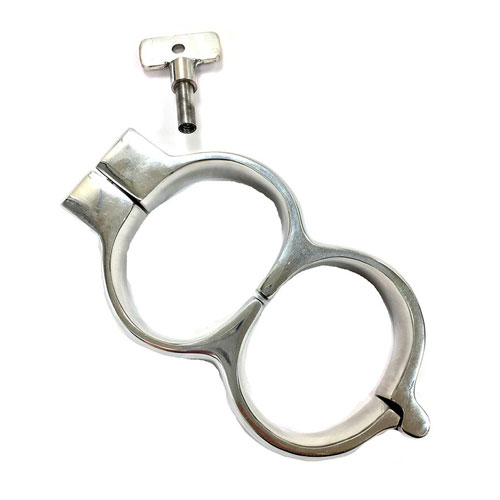
Rouge Stainless Steel Lockable Wrist Cuffs
Stainless steel cuffs, the durable end of the hardware range. ~£79.
£78.99 →When hardware matters most
| Use | Hardware demand | Why |
|---|---|---|
| Anchor-point restraint (to bed, frame, furniture) | Critical | Takes the full load if the restrained person pulls |
| Wrist-to-wrist or limb-to-limb cuffs | High | Takes dynamic force from movement |
| Spreader bar connections | High | Continuous tension across the bar |
| Collar D-ring used as a lead point | High | Takes directional load |
| Decorative rings, never load-bearing | Low | Aesthetic only, no force on them |
| Light sensation pieces, no tension | Low | Never takes load |
When it genuinely doesn't matter
The honest other half of this: you do not need premium welded steel on everything. A decorative ring on a piece of lingerie that will never take tension can be whatever it is. A light fabric tickler's trim does not need 316 steel. Spending premium-hardware money on purely decorative or non-load-bearing components is just spending. The rule is targeted: welded, quality hardware on anything that restrains; whatever is fine on anything that does not. Knowing which is which is the actual skill.
How to check hardware on a piece you own
- Inspect every load-bearing ring. Look for the gap or seam of a split ring. Welded rings are continuous.
- Check for plating wear. Chips, flaking, or a different-coloured metal showing through means plated pot-metal, not solid steel.
- Test the buckles and clips. They should move cleanly and hold firmly. Stiffness, grit or play is wear.
- Look for corrosion. Rust or pitting on something sold as stainless steel means it was not, or the plating has failed.
- Retire failed hardware. A spread ring or a cracked clip is not repairable. The piece is done as a load-bearing item.
Common mistakes
- Trusting split rings on load-bearing gear. The classic failure. Welded only, on anything that restrains.
- Assuming "metal" means "steel". Plated pot-metal looks like steel until the plating chips. Check the grade.
- Paying premium for decorative hardware. Non-load-bearing rings do not need 316 steel. Spend where the force is.
- Ignoring plating wear. Exposed base metal can react with skin and is a sign the component is failing.
- Repairing failed hardware. A spread ring or cracked clip is done. Retire the piece as load-bearing.
Related reading
- On leather: bridle, suede and bonded
- Best beginner BDSM kit UK
- Custom furniture vs off-the-shelf
- Browse bondage range
Frequently asked
- What is the difference between welded and split rings?
- A welded ring is a continuous closed loop with the join fused, it has no gap and cannot pull open. A split ring has a gap where the ends meet, and under load that gap can spread, the ring straightens out, and the restraint fails. On any load-bearing bondage gear, welded rings are non-negotiable.
- What steel should bondage hardware be made of?
- 304 or 316 stainless steel. Both are corrosion-resistant, hold their strength, are body-safe, and have no coating to shed. 316 ("marine grade") is the more corrosion-resistant. Avoid plated pot-metal or zinc alloy, where a weak base metal sits under a thin plating that chips and wears.
- How do I check if bondage hardware is good quality?
- Inspect every load-bearing ring for the gap or seam of a split ring (welded rings are continuous). Check for plating wear, chips or a different metal showing through. Test buckles and clips move cleanly and hold firmly. Look for rust or pitting on anything sold as stainless steel. Retire any spread ring or cracked clip.
- Does all bondage gear need premium hardware?
- No. Welded, quality hardware is essential on anything that restrains, anchor-point ties, cuffs, spreader bars, collar lead points. Purely decorative rings and light sensation pieces that never take tension do not need premium steel. The skill is knowing which components actually bear load.
- When does hardware quality matter most?
- Anything load-bearing: restraint connected to an anchor point (bed, frame, furniture), wrist-to-wrist or limb-to-limb cuffs, spreader bar connections, and a collar D-ring used as a lead point. These take the full or dynamic load if the restrained person moves or pulls, so the hardware has to hold.
- What is wrong with plated pot-metal hardware?
- It is a weak base metal under a thin plated finish. The plating wears or chips, exposing a base metal that can react with skin, and the base metal itself can be brittle and crack under load. It looks like solid steel until it fails. Common on bargain hardware.
- Can I repair a bondage ring that has pulled open?
- No. A ring that has spread under load, or a cracked clip, is not repairable as a load-bearing component, the metal has been compromised. Retire the piece as a restraint. Trying to bend a spread ring back is exactly the kind of patched hardware that fails again under load.
- Where can I buy quality stainless steel bondage hardware in the UK?
- BondageBox stocks restraints and cuffs with welded hardware and 304/316 stainless steel components, with free discreet UK delivery over £30 and plain unmarked packaging. Browse the bondage range.
Sources & further reading
- BSI, UK product safety standards, British Standards Institute
- NCSF, Consensual kink safety standards, National Coalition for Sexual Freedom
- St John Ambulance, Circulation and first aid, St John Ambulance UK
Filed under Materials & Care
← Back to the Guides