




Sensory deprivation removes sight, and sometimes sound and touch, to heighten everything that remains. A bondage hood is the equipment most associated with it, but the honest starting point for almost everyone is not a hood at all, it is a blindfold: it delivers the core effect (removing sight) with none of the risk, and most people find it is as far as they want to go. If you do move to a hood, the single rule that governs everything is breathing: a hood must never restrict the airway, which is why open-face and open-nostril hoods are the only beginner-safe option, and why a full closed hood is an advanced piece that demands experience, trust and constant monitoring. The appeal of sensory deprivation is real: removing one sense floods the others, deepens headspace, and intensifies trust. But the gear sits on a clear risk ladder, blindfold, then open hood, then (much later, if at all) closed hood, and skipping rungs is where it goes wrong. This guide covers the ladder, the breathing rule, and how to start.
Bondage hood, sensory deprivation, sensory deprivation hood
"Bondage hood", "sensory deprivation hood" and "sensory deprivation" describe related things: the practice of removing senses to heighten the rest, and the equipment that does it. The equipment runs from a simple blindfold to a full enclosing hood; the practice is the same idea at every level, just at different intensities and risk.
Why sensory deprivation works
Remove one sense and the brain reallocates attention to the others. Take away sight and touch becomes vivid, sound becomes sharp, anticipation becomes everything, you cannot see what is coming, so every sensation lands fully. It also deepens headspace and trust: being unable to see means relying entirely on a partner, which for many people is the core of the appeal. Sensory play pairs naturally with restraint and is one of the most accessible ways to intensify a scene without adding intensity of force.
The effect is not just subjective. Neuroscience research on "cross-modal plasticity" shows the brain rapidly reallocates resources from a deprived sense to the others: in one University of Montreal study, adults blindfolded for 90 minutes performed significantly better at fine sound-discrimination tasks than a non-blindfolded control group. Removing sight, even briefly, measurably sharpens what is left, which is exactly the mechanism a blindfold or hood puts to use.
The risk ladder: start at the bottom
| Level | Equipment | Removes | Who it is for |
|---|---|---|---|
| 1 | Blindfold | Sight | Everyone, the right starting point |
| 2 | Open-face / open-nostril hood | Sight, some sound, the feeling of enclosure | Those who enjoyed the blindfold and want more, with the airway always clear |
| 3 | Fuller enclosing hood | Sight, most sound, touch on the head | Experienced practitioners only, demands trust and constant monitoring |
The ladder is not a progression you are obliged to climb. Most people find level 1 or 2 is everything they want. The mistake is jumping straight to level 3.
Start with a blindfold
A blindfold is the highest pleasure-per-pound item in sensory play and the correct first step for everyone. It removes sight, the sense whose removal does the most, with zero airway risk and no learning curve. A padded blindfold is more comfortable and blocks light better than a flat strip. Spend real time here before considering a hood; for many people the blindfold is the whole of sensory deprivation, and that is a complete and good place to be.
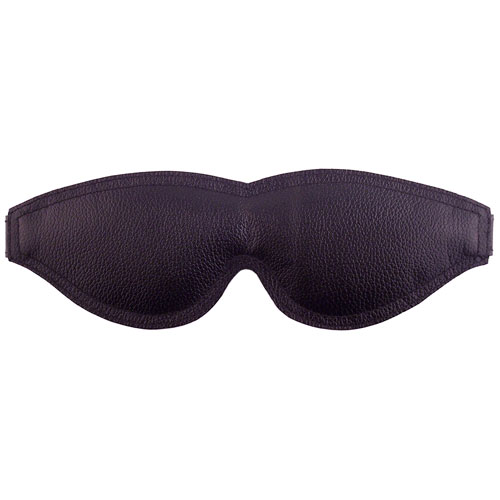
Rouge Garments Padded Blindfold
The correct first step into sensory deprivation. ~£28.
£27.99 →If you move to a hood: open-face only, to start
If the blindfold has shown you that you want more, the next step is an open-face or open-nostril hood, one that encloses the head and adds the feeling of being hooded, while leaving the nose and mouth, or at minimum the airway, completely clear. The added effects over a blindfold are the sense of enclosure and some muffling of sound, both of which deepen the headspace. What does not change is the breathing rule: the airway stays open, always, no exceptions. A closed full hood is a different category of equipment for experienced practitioners only.
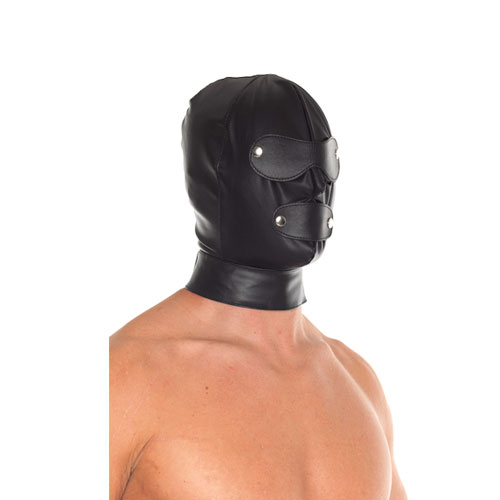
Leather Mask with Detachable Blinkers
Open-face leather mask, enclosure with the airway clear. ~£118.
£117.99 →The breathing rule
This rule sits above every other consideration: a hood must never restrict breathing. That means:
- The nose and mouth (or at minimum the nostrils) stay unobstructed, always. Open-face and open-nostril designs are built around this. Closed designs are not beginner equipment.
- Never combine a hood with a gag without experienced knowledge and constant monitoring; the two together compound airway risk.
- Watch for breathing changes throughout, the active partner monitors continuously, not occasionally.
- Agree a non-verbal safe signal, since a hooded (and possibly gagged) person may not be able to speak; a held-object drop is the standard.
- Never leave a hooded person alone, not for a moment.
Other safety basics
- Body-safe materials against the face: quality leather, neoprene or latex from a known maker. Patch-test latex for allergy.
- Keep sessions short to start. Sensory deprivation is intense; build up.
- Temperature. Hoods trap heat; a warm room plus a hood gets uncomfortable fast.
- Check in often. A deprived person cannot read the room; the active partner does it for both.
- Have an exit plan. The hood should come off fast if needed, know how before you start.
Common mistakes
- Skipping the blindfold. It is the right first step and often the whole journey. Do not jump past it.
- Buying a closed full hood as a first hood. Closed hoods are advanced equipment. Open-face only, to start.
- Combining a hood and a gag without experience. The two together compound airway risk.
- No non-verbal safe signal. A hooded person may not be able to speak. Agree a held-object drop first.
- Leaving the person alone. Never, not for a moment, with any level of sensory deprivation.
Related reading
- Nipple clamps for beginners UK
- Sensation play
- Ball gags and gags for beginners
- Safe words explained (including non-verbal)
- Browse bondage hoods and masks
Frequently asked
- What is a bondage hood?
- A bondage hood is a head covering used in sensory deprivation play, ranging from open-face designs that leave the airway and often the face clear to full closed hoods. It removes sight, adds a sense of enclosure, and muffles sound, heightening the remaining senses. Open-face hoods are beginner-safe; closed hoods are advanced equipment.
- Where should a beginner start with sensory deprivation?
- With a blindfold, not a hood. A blindfold removes sight, the sense whose removal does the most, with zero airway risk and no learning curve. Most people find the blindfold is everything they want from sensory deprivation. Only move to an open-face hood after that, and a closed hood is for experienced practitioners only.
- Are bondage hoods safe?
- Open-face and open-nostril hoods, used correctly, are safe for beginners: the airway stays completely clear, sessions are kept short, the person is never left alone, and a non-verbal safe signal is agreed in advance. Closed full hoods carry real airway risk and are advanced equipment requiring experience and constant monitoring.
- What is the most important rule with bondage hoods?
- Breathing. A hood must never restrict the airway. The nose and mouth, or at minimum the nostrils, stay unobstructed at all times, which is why open-face and open-nostril designs are the only beginner-safe option. Never combine a hood with a gag without experienced knowledge and constant monitoring.
- Can you combine a bondage hood with a gag?
- Not as a beginner. A hood and a gag together compound airway risk and demand experienced knowledge plus constant monitoring. For anyone new to sensory deprivation, the hood alone, open-face, with the airway fully clear, is the limit.
- How do you communicate while wearing a hood?
- With a pre-agreed non-verbal safe signal, because a hooded person may not be able to speak clearly. The standard is a held-object drop: the person holds a small object and dropping it means stop. The active partner must also monitor breathing and body language continuously.
- What materials are bondage hoods made of?
- Commonly leather, neoprene or latex. Choose body-safe materials from a known maker for anything against the face, and patch-test latex for allergy before use. Hoods also trap heat, so a cool room and short sessions matter.
- Where can I buy a bondage hood in the UK?
- BondageBox stocks blindfolds, open-face masks and hoods with free discreet UK delivery over £30, plain unmarked packaging, and "BBox" on the bank statement. Start with a blindfold; browse the bondage hoods and masks range.
- Does removing one sense really heighten the others?
- Yes, and there is research behind it. Neuroscience on "cross-modal plasticity" shows the brain quickly reallocates resources from a deprived sense to the rest; one University of Montreal study found that adults blindfolded for just 90 minutes performed significantly better at fine sound-discrimination than a control group. A blindfold or hood is putting a real, measurable mechanism to use.
Sources & further reading
- NCSF, Consensual kink safety standards, National Coalition for Sexual Freedom
- St John Ambulance, First aid and breathing, St John Ambulance UK
- Brook, Sex and consent, Brook Advisory
- Cross-modal effects of sensory deprivation: a systematic review, Neural Plasticity (2019)
Filed under Beginner's Guides
← Back to the Guides