



The G-spot is an area, not a button. It sits on the anterior (front) wall of the vagina, roughly 5 to 7cm inside, and it is most easily found by inserting a curved finger or a curved G-spot toy and pressing gently upward (toward the navel) rather than straight in. The texture is slightly rougher or more ridged than the surrounding tissue, and the response is to firm, rhythmic pressure rather than rapid friction or vibration alone. Anatomically, current research (MRI work by Foldès and Buisson, and others) places the G-spot as part of the wider internal clitoral complex, not a separate organ. Some people have a strong G-spot response; others have little or none, and both are normal. This is the plain UK guide to finding it, alone or with a partner.
G-spot, the female G-spot, G-spot location
"G-spot", "the female G-spot" and "G-spot location" describe the same anatomical area: a sensitive zone on the anterior vaginal wall named in the 1980s after the German gynaecologist Ernst Gräfenberg. The terminology has stayed in common use even as the underlying anatomy has been better mapped.
What the G-spot actually is
The research consensus has shifted. The G-spot is not a discrete organ; it is the zone of tissue on the anterior vaginal wall most closely overlapping the internal clitoral complex, the parts of the clitoris that sit inside the body, and the surrounding urethral sponge. MRI and anatomical research published by Pierre Foldès, Odile Buisson and colleagues from 2008 onward has documented this overlap: stimulating the G-spot area is, in effect, stimulating the back of the internal clitoris through the vaginal wall.
This explains two practical things: why the G-spot response is real for many people, and why "G-spot pleasure" and "clitoral pleasure" are often experienced as related rather than separate.
The anatomy, in plain terms
- Where it is. Anterior (front) vaginal wall, around 5 to 7cm inside the entrance. Up, toward the navel, when you are lying on your back.
- What it feels like. Slightly rougher, sometimes spongier or more ridged than the surrounding smooth tissue. The texture is the cue.
- What it responds to. Firm, rhythmic pressure, often described as "come-hither" motion with a curved finger or toy. Rapid friction and pure vibration are less effective than steady pressure.
- What changes during arousal. The area swells and becomes more textured as arousal builds, making it noticeably easier to find a few minutes into stimulation than at the very start.
How to find it on your own
- Get aroused first. Cold-start finding is harder; spend 5 to 10 minutes on external stimulation (clitoris, vulva, breasts) before going looking. The G-spot area is more prominent when blood flow has increased.
- Find a comfortable position. Squatting or lying on your back with knees up are the two easiest. Standing with one foot raised also works.
- Use a curved finger. Apply water-based lubricant. Insert the index finger up to the second knuckle, palm facing up. Curl the finger gently as if signalling "come here", pressing the pad against the front wall.
- Feel for texture. The G-spot zone is slightly rougher or more ridged than the smoother surrounding tissue. You may also feel a small swelling.
- Apply rhythmic pressure. Steady "come-hither" motion rather than rapid rubbing. Stay with it; sensations build over a minute or two rather than registering instantly.
How to find it with a partner
A partner's index or middle finger reaches the area more easily than your own. The position and motion are the same: palm up, curl, "come-hither" pressure on the anterior wall around 5 to 7cm in. The receiver giving verbal direction ("a bit deeper", "less pressure", "stay there") is what makes this go well; partners cannot read the response by feel alone.
For penetrative G-spot contact, the positions that work best are ones that angle the penis or dildo toward the front wall. Woman-on-top with a forward lean, or rear-entry with the receiver lowering the upper body, both bring the front wall into contact.
How to find it with a toy
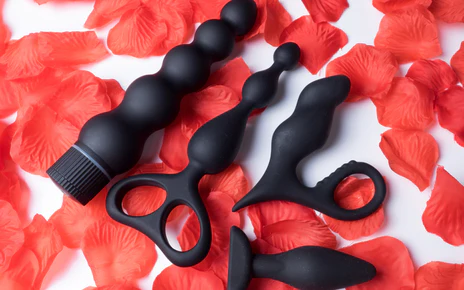
This is often easier than fingers. A curved G-spot vibrator, a slim insertable with a deliberate angle at the tip, is designed exactly to reach the anterior wall.
- Apply water-based lubricant generously.
- Insert slowly with the curve pointing up (toward the navel).
- Once inside, press gently up rather than thrusting; the curve does the work.
- Rhythmic pressure, not rapid in-out motion, is what the G-spot responds to.
- Many people prefer to combine internal pressure with external clitoral stimulation, which is why rabbit vibrators exist.
See the G-spot vibrators UK buyer's guide for the toy-selection side, and bullet vs wand vs rabbit for how the rabbit's combined approach works.
What "G-spot orgasm" actually means
Some people report a distinct G-spot orgasm: deeper, more diffuse, sometimes accompanied by squirting (fluid release from the urethra). Others find G-spot stimulation enhances clitoral orgasm rather than producing a separate one. Both are well-documented and normal.
Equally normal: not having a strong G-spot response at all. Research consistently finds wide individual variation, and the absence of G-spot pleasure is not a problem or a failure; it is part of how human bodies vary. Clitoral pleasure is the universal route for the large majority of women, with or without G-spot involvement.
Approaches compared
| Approach | Setup | Best for |
|---|---|---|
| Solo, with fingers | Aroused first, squatting or knees-up, curled index finger | Learning the anatomy, finding the texture |
| Partnered, with fingers | Receiver gives verbal direction; "come-hither" pressure | Reaching the area easily and building intensity |
| Solo, curved G-spot toy | Curved insertable, lube, pressure up rather than thrust | The most reliable way for many people |
| Solo, rabbit vibrator | Curved internal arm + external clitoral arm | Combined G-spot and clitoral, often the most pleasurable |
| Penetrative position | Woman-on-top forward lean, or angled rear-entry | G-spot contact in partnered penetrative sex |
Common mistakes
- Going too deep. The G-spot zone is 5 to 7cm in. Going deeper looks past it.
- Pure vibration with no pressure. Vibration alone is less effective than steady pressure; this is why a generic dildo without a curve sometimes "doesn't work" for G-spot stimulation.
- Cold start. Trying to find the area before arousal makes it harder; warm up first.
- Treating it like a button. The G-spot is a zone, and the response builds over a minute or two of rhythmic pressure, not instantly.
- Assuming you must have a strong response. Some people do, some do not, and both are normal.
The other "spots": A-spot, U-spot, and cervical orgasm
The G-spot is the most-discussed but not the only internal pleasure zone. Three others come up in the research and in practice often enough to be worth knowing about:
- A-spot (anterior fornix erogenous zone, or AFE). Described by Malaysian physician Chua Chee Ann in research papers from the 1990s, the A-spot sits deeper than the G-spot, on the same anterior wall but around 10 to 12cm inside, just in front of the cervix. The response is to firm pressure rather than rapid friction, and many people who find G-spot stimulation produces little also report a strong response from the A-spot. A curved vibrator with enough length to reach it, or a partner-led position that allows deeper angled contact, is the practical access point.
- U-spot (urethral opening). The small area immediately around the urethral opening, just above the vaginal entrance and below the clitoris, is densely innervated and responds to gentle external stimulation. Most accidental "G-spot" discoveries during external play are actually the U-spot. A finger or the tip of a bullet vibrator, used gently, is enough.
- Cervical orgasm. A distinct deep-penetration response, less universal than clitoral orgasm but described consistently in qualitative research (Komisaruk and colleagues, Rutgers University, have mapped neural pathways from the cervix that bypass the standard pudendal route). Requires deep, sustained pressure on the cervix itself, often only achievable in specific positions with a partner. Pain rather than pleasure is the common first response; it builds with familiarity for those who experience it.
The wider point: if the G-spot does not produce a strong response for you, the rest of the internal map is worth exploring before concluding that internal stimulation "does not work". Most people who report rich internal pleasure draw on a combination of zones rather than the G-spot alone. See G-spot vibrators UK for toys with the length and curve to reach beyond the G-spot.
Related reading
- G-spot vibrators UK buyer's guide
- How to use a vibrator UK
- Bullet vs wand vs rabbit vibrators UK
- Best vibrators UK
- Beginner's guide to lubricant types
- Browse clitoral and G-spot toys
Frequently asked
- Where is the G-spot?
- On the anterior (front) wall of the vagina, roughly 5 to 7cm inside the entrance, toward the navel when lying on your back. The texture is slightly rougher or more ridged than the surrounding tissue, and it becomes more prominent during arousal.
- What does the G-spot feel like to touch?
- Slightly rougher or spongier than the smooth surrounding vaginal wall, sometimes with a small swelling once aroused. The texture is the cue. The response is to firm, rhythmic "come-hither" pressure rather than rapid rubbing or pure vibration.
- Is the G-spot the same as the clitoris?
- Not the same, but closely related. MRI research by Foldès, Buisson and colleagues has shown the G-spot zone overlaps with the internal clitoral complex and urethral sponge. Stimulating the G-spot area effectively stimulates the back of the internal clitoris through the vaginal wall.
- Why can't I find my G-spot?
- Three common reasons: not aroused enough first (the area is much easier to find a few minutes into stimulation), going too deep (it sits 5 to 7cm in, not further), or using vibration without pressure (it responds to firm rhythmic pressure rather than rapid motion). Some people also simply have less G-spot response, which is normal.
- What position is best for G-spot stimulation in partnered sex?
- Positions that angle the penis or dildo toward the front vaginal wall: woman-on-top with a forward lean, or rear-entry with the receiver lowering the upper body. A curved G-spot dildo with strap-on play also targets the area directly.
- What toy is best for finding the G-spot?
- A curved G-spot vibrator: a slim insertable with a deliberate angle at the tip, designed to reach the anterior wall. Insert with the curve pointing up, then press gently rather than thrust. Many people prefer a rabbit vibrator for combined G-spot and external clitoral stimulation. See the G-spot vibrators buyer's guide.
Sources & further reading
- NHS, Sexual health hub, NHS UK
- Brook, Sex and pleasure, Brook Advisory
- Kinsey Institute, Sexual response research, Kinsey Institute
- ACOG, Women's health and anatomy resources, American College of Obstetricians and Gynecologists
Filed under Techniques
← Back to the Guides

