


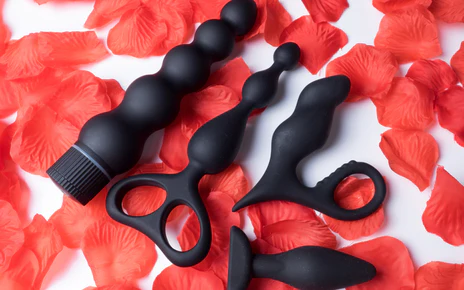


The short version of how to use a vibrator is: charge it fully, find a private and unhurried half-hour, start on the lowest setting, use a fragrance-free water-based lubricant, and move it slowly across the clitoris, vulva, perineum and, for internal toys, the front wall of the vagina, rather than pressing it into one spot. Most people find their preferred setting is lower than they expected. Vibrator use is also mainstream: a nationally representative Indiana University survey published in the Journal of Sexual Medicine found 52.5% of US women and 44.8% of US men had used a vibrator, with use associated with higher sexual-function scores. This guide is the plain UK walkthrough of your first session, where it goes, what to do with it, and what to expect. For choosing which vibrator to buy in the first place, see the first-vibrator buyer's guide.
Using a vibrator, vibrator how-to, first sex toy
"How to use a vibrator", "vibrator how-to" and "first sex toy" all circle the same beginner question: how does this actually work, where does it go, what do I do with it. The answer is more about pace and pressure than technique. Charge, lube, low setting, move it around, listen to your body.
Before the first session
- Charge it fully. A rechargeable vibrator or wand should be at full charge; a mains-powered wand needs a nearby socket. Running out mid-session is an avoidable annoyance.
- Read the IPX rating. Only IPX7-rated vibrators are safe in the bath or shower. Splash-resistant means wipe-clean only; keep it dry.
- Pick a private, unhurried 30 to 60-minute window. The first session is about learning the toy, which is hard against the clock or within earshot.
- Have a fragrance-free water-based lubricant to hand. Silicone lube degrades silicone toys, so water-based is the universal-compatible default, see the lubricant guide.
- Find a comfortable position. Most people start lying back, propped against pillows, but seated or standing also work, whichever lets you focus on the sensation rather than the position.
Where it goes: the external map
A vibrator's job is to deliver sensation; where on the body decides which sensation:
- Clitoral hood, then the clitoris itself. The most-responsive area for most people. Indiana University surveys consistently find that a large majority of women report orgasm through clitoral rather than vaginal stimulation. Start with the hood (light contact, through the soft skin above the clitoris) and only move to direct contact if you want more intensity.
- Vulva and labia. Broad, slow strokes warm the area and raise sensitivity; this is the right opening move before any clitoral focus.
- Perineum. The area between the genitals and anus, densely innervated, responds to vibration for many people regardless of anatomy.
- Nipples, neck, inner thighs. Non-genital but vibration-responsive. A smaller bullet vibrator across these areas is a common warm-up move.
- Penis and perineum. Vibrators are not anatomy-specific. A wand or bullet against the perineum, the frenulum, or along the shaft is intensely pleasurable for many.
Internal use, if you want it
If the vibrator is designed for internal use, a G-spot insertable, a rabbit, or a smooth dildo-shaped piece, the practical points:
- Apply water-based lubricant generously, to the toy and to the entrance. Internal use needs more lubricant than external; reapply if it dries.
- Insert slowly, with the toy angled toward the front wall of the vagina (toward the navel) for G-spot contact. The G-spot, the area of the anterior vaginal wall around 5 to 7cm inside, is most responsive to firm, rhythmic pressure rather than rapid vibration alone, see the G-spot guide.
- For most people, internal vibration alone produces a different response from combined internal-and-clitoral stimulation. Rabbit vibrators are designed for exactly that combination.
- Comfort first, depth second. If anything pinches or aches, change angle or back off; depth is not the point of the experience.
The patterns: build, hold, ease, restart
Most first-time users expect to find one setting and one position that "works". The reality is more dynamic:
- Build. Start with broad, gentle contact and increase intensity slowly. Vibrator sensation is cumulative; rushing flattens the experience.
- Hold. Once you find the right contact and intensity, holding it steady, rather than moving constantly, often does more than continuous motion.
- Ease. If the area starts to feel numb, ease off, lower the intensity, or move to a different spot. Numbness is not a sign to push through; it is the sign to back off.
- Restart. Orgasm is not always a single peak. Many people find the second round, after a brief pause, more satisfying than the first.
Vibrator types at a glance
| Type | Where it goes | Best for |
|---|---|---|
| Bullet | External, pinpoint | First vibrator, discreet, partner-friendly |
| Wand | External, broad head | Strongest external sensation, partner-friendly |
| G-spot insertable | Internal, anterior wall | Internal stimulation, typically a curved tip |
| Rabbit | Internal + external clitoral arm | Combined stimulation, the classic "double" vibrator |
| Clitoral suction / air-pulse | Hood and clitoris | A specific non-vibrating "sucking" sensation |
For the buying decision behind each type, see the first-vibrator guide and the bullet vs wand vs rabbit comparison.
The lubricant choice
- Water-based is the universal default, compatible with every toy material (including silicone) and every condom type. Reapply with a drop of water if it dries.
- Silicone-based lasts longer but degrades silicone toys, so use it only with glass, steel, ABS or ceramic toys.
- Avoid flavoured, warming or numbing lubes for a first session, the added agents are the most common irritants.
Cleaning, after every use
- Wipe or rinse with warm water and a fragrance-free toy cleaner or mild soap.
- Most vibrators are wipe-clean only because the motor is inside; only IPX7-rated toys can be fully rinsed under water.
- Dry fully before storage, and store in a fabric pouch or its own box, separately from other silicone pieces.
- The fuller protocol is in how to clean sex toys UK and how to clean silicone toys.
Common first-time mistakes
- Going to full power immediately. The sensation flattens rather than builds. Start low, build up only if you want more.
- Direct clitoral contact from the start. Many people find the hood (the softer area above) is the right opening; direct contact comes later, if at all.
- Forgetting lube. Even for external use, a thin layer of water-based lube makes the head glide more comfortably.
- Watching the clock. The right session length is whatever the body needs; nothing useful happens on a timer.
- Cleaning by submersion on a non-IPX7 toy. Kills the motor. Check the rating before any water contact.
Using a vibrator with a partner
A vibrator brought into partnered sex is a different exercise from solo use, and almost every couple who introduces one well does the same three things:
- Have the conversation outside the bedroom. Not on the threshold; days before. "I have been thinking about trying this, and I would like it with you." Curiosity language opens; commitment language closes. See how to talk about kink.
- Position the vibrator as additive, not replacement. Frederick and colleagues (2018, Archives of Sexual Behavior) found the orgasm gap in heterosexual couples closes dramatically when encounters include a vibrator alongside other activity, not when penetration is simply extended. The toy adds; it does not substitute.
- Hand over the control. Couples who get the most from a partnered vibrator usually let the receiving partner direct: which area, which intensity, when to stop. The active partner holds and moves; the receiver tells them what is working. This single change shifts a partnered session from "guessing" to "responding".
For the buying decision behind partner-friendly vibrators specifically (long handles, broad heads, app or remote control), see sex toys for couples UK and foreplay ideas UK. For the broader couples conversation about novelty itself, reigniting after a quiet patch covers the relational frame.
Related reading
- How to choose your first vibrator UK
- Bullet vs wand vs rabbit vibrators UK
- First time with a wand massager
- Beginner's guide to lubricant types
- How to clean sex toys UK
- Browse sex toys
Frequently asked
- How do I use a vibrator for the first time?
- Charge it fully, find a private and unhurried half-hour, start on the lowest setting, and use fragrance-free water-based lubricant. Move the vibrator slowly across the clitoral hood, vulva and perineum rather than pressing it into one spot. Build intensity only if you want more, and stop on any numbness.
- Where exactly does a vibrator go?
- Most people start externally on the clitoral hood and the surrounding vulva, where the response is strongest. Bullet and wand vibrators are external; G-spot insertables and rabbits combine internal use with the anterior vaginal wall and, in the rabbit's case, an external clitoral arm. Vibrators also work on the perineum, nipples and shaft for any anatomy.
- Do I need lubricant with a vibrator?
- Yes, even for external use. A thin layer of fragrance-free water-based lube makes the head glide more comfortably and avoids friction. Water-based is the universal-compatible default; silicone lube lasts longer but degrades silicone toys, so use it only with glass, steel, ABS or ceramic.
- How common is vibrator use?
- Very. A nationally representative Indiana University study published in the Journal of Sexual Medicine found 52.5% of US women and 44.8% of US men had used a vibrator at some point, with use linked to higher sexual-function scores. A first vibrator is a step into a mainstream category, not an unusual one.
- What setting should I start on?
- The lowest. Vibrator sensation is cumulative; starting at full power flattens the build and often produces numbness rather than pleasure. Most first-time users settle on a setting one or two steps up from the bottom, not the top. There is no prize for using full power.
- How do I clean a vibrator?
- Warm water and a fragrance-free toy cleaner or mild soap, worked over every surface, then dried fully. Most vibrators are wipe-clean only because the motor is inside; only IPX7-rated toys can be fully rinsed. Store dry, in a fabric pouch or its own box.
Sources & further reading
- NHS, Sexual health hub, NHS UK
- Brook, Sex and pleasure, Brook Advisory
- Kinsey Institute, Sexual response research, Kinsey Institute
- Prevalence and characteristics of vibrator use by women in the US, Journal of Sexual Medicine
Filed under Beginner's Guides
← Back to the Guides