


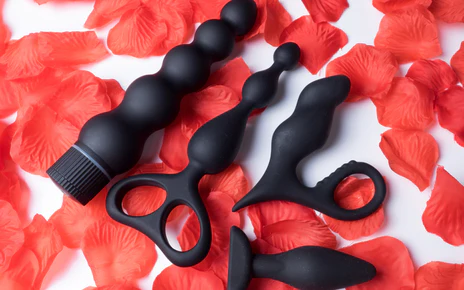

STI status affects sex toy practice but doesn't preclude it. The protocols are well-established; UK NHS sexual-health services support honest conversations about these.
Solo use with an STI
Your own toys with your own body during an STI: safe. You can't catch your own STI from yourself.
Considerations:
- Active outbreak (herpes, etc.), toy use on affected skin can prolong healing. Wait for resolution.
- Open sores or lesions, toy contact can introduce bacteria; risk of secondary infection.
- Active infection of any kind (UTI, BV, thrush), toy use can re-introduce the infection as you recover. Skip until cleared.
For ongoing STIs (managed HSV, HIV with undetectable viral load, etc.), toy use is fine; standard cleaning applies.
Partnered or shared use with an STI
This is where careful practice matters. The transmission pathways:
- Direct contact, toy in body → toy in another body within minutes.
- Surface contamination, virus / bacteria survive on toy surfaces; transferred in subsequent use.
- Porous-material harbouring, TPE / jelly hold pathogens that can't be cleaned out.
The protocol
- Avoid porous-material toys for shared use. Platinum-cure silicone, glass, steel only. See is jelly rubber safe.
- Use a condom on the toy, change between users. Same as a partner; barrier breaks the transmission path.
- Sterilise between sessions, boil silicone/glass/steel for 3 minutes, or 70% IPA wipe. See sterilising sex toys.
- Don't share during active outbreaks, HSV, gonorrhoea, etc.
- Avoid sharing between anal and vaginal use without cleaning, gut bacteria into vaginal microbiome causes UTI / BV regardless of STI status.
STI-specific notes
HSV (herpes)
Viral; can survive on toy surfaces for hours. Sterilisation kills it. Active outbreaks: wait. Non-active: standard protocol.
HPV
Surface-stable; sterilisation handles it. Most HPV strains are cleared by the immune system over time; toys aren't a major transmission vector for stable infections.
Gonorrhoea, chlamydia
Bacterial; killed by alcohol or heat. Standard sterilisation protocol works. Don't share during active untreated infection.
HIV
Doesn't survive long outside the body in air. Routine cleaning eliminates transmission risk; partners on effective treatment (undetectable viral load) have essentially no transmission risk through any route. UK guidance from Terrence Higgins Trust.
Syphilis
Bacterial; survives briefly outside the body. Standard sterilisation protocol; standard contact precautions during treatment.
The conversation with a partner
Disclosure conversations are difficult; UK sexual-health charities provide frameworks:
- Brook Advisory, counselling resources on STI disclosure.
- Terrence Higgins Trust, particularly HIV-focused.
- FPA, general STI information and disclosure resources.
UK legal guidance: not disclosing certain STIs (HIV specifically, but principles extend) when knowingly transmitting may carry legal consequences. Voluntary disclosure is the safer practice.
Getting tested
UK STI testing options:
- NHS sexual-health clinics: Free; confidential; no GP referral needed. Search "sexual health clinic near me".
- Brook (under 25): Free testing and counselling.
- Online postal testing: Free in many UK regions via NHS-commissioned services; SH:24, Sexual Health London.
Regular testing (annually for adults with multiple partners) is the standard recommendation. After new partners: 1-3 months for window-period accuracy.
When to seek medical advice
- New unusual discharge.
- Genital sores, blisters, or rash.
- Burning during urination.
- Lower abdominal pain.
- Unusual smell.
- Symptoms after new partner.
NHS routes for all of these are straightforward.