




This is a map, not a manual. Before you learn how to do anything in bondage, it helps to know what the landscape looks like, what the words mean, where the practices sit relative to each other, and what connects to what. Bondage itself is just one part of the wider BDSM umbrella, specifically the consensual physical restraint of a partner. Around it sit related practices: discipline, dominance and submission, sensation play, impact play. The tools divide into a few clear families: soft restraints (cuffs, ties), rope, furniture and hardware, and sensory gear (blindfolds, gags). And running underneath all of it is a single non-negotiable framework: consent, negotiation, safewords, aftercare. This guide orients you. For the step-by-step how-to-start, see bondage for beginners UK.
Bondage, BDSM, kink
The words first, because they get used loosely. "Kink" is the broadest term, any sexual interest outside the conventional. "BDSM" is a specific cluster within kink: Bondage, Discipline, Dominance, Submission, Sadism, Masochism. "Bondage" is the B, the consensual physical restraint of a partner. So bondage sits inside BDSM sits inside kink. When people say they are "into bondage", they usually mean the restraint specifically, though it often travels with the other letters.
Where bondage sits
Bondage is the most concrete entry point into BDSM, which is why so many people start here. It is physical and visible, the equipment is tangible, and the negotiation is straightforward: you can point at exactly what you are agreeing to. Compare that to dominance and submission, which is psychological and harder to define, or sadism and masochism, which is about sensation intensity. Bondage is the part of the map you can read most easily, which makes it the natural first territory.
It is also among the most common. A 2017 study in the Journal of Sex Research (Joyal and Carpentier) surveyed 1,040 adults and found that 46.8% had engaged in at least one BDSM-adjacent activity, with restraint and light bondage consistently among the most-reported. Far from a fringe interest, bondage is the corner of the map most people who explore BDSM actually visit.
The tool families
| Family | What it covers | Where beginners start |
|---|---|---|
| Soft restraints | Padded cuffs, fabric ties, under-bed systems | Yes, the standard entry point |
| Rope | Cotton, jute, hemp; ties from simple to shibari | Later, after cuffs, with technique learning |
| Furniture and hardware | Spreader bars, benches, crosses, frames | Hardware early, fixed furniture much later |
| Sensory gear | Blindfolds, gags, sensation tools | Yes, blindfolds especially, immediately |
The pattern: soft restraints and blindfolds are the beginner territory, rope and fixed furniture are the next territory, and they are reached deliberately, not stumbled into.
The adjacent practices
Bondage rarely travels alone. The practices most commonly found alongside it:
- Sensation play: heightening or varying physical sensation, ticklers, temperature, texture. Pairs naturally with restraint and a blindfold.
- Impact play: spanking, paddles, floggers, the sting-to-thud spectrum. A common next interest after restraint.
- Dominance and submission: the power-exchange dynamic. Bondage can be purely physical or it can carry a D/s charge; both are valid.
- Discipline: rules, structure, consequence. More psychological, often layered onto the others.
You do not need to engage with any of these to enjoy bondage. But knowing they exist on the map explains a lot of the vocabulary you will encounter.
The framework underneath everything
One thing is not optional and not a "later" topic: the consent framework. Every responsible bondage practice rests on it, and it has four parts:
- Negotiation: agreeing in advance what is on and off the table, before anything starts.
- Safewords: a pre-agreed signal that pauses or stops everything. The traffic-light system is the UK standard.
- Limits: hard limits (never) and soft limits (with discussion), stated explicitly.
- Aftercare: the deliberate wind-down afterward, water, warmth, reconnection.
This framework is not a constraint on bondage; it is what makes bondage work. It is the legend on the map.
The standard beginner kit
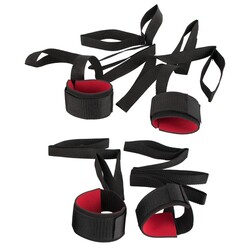
Soft Bondage Kit
Soft cuffs, blindfold, tickler, the beginner territory in one box. ~£22.
£21.99 →How to use this map
Start in the beginner territory: soft restraints and a blindfold, with the consent framework in place from the first session. Spend real time there. Move to rope or impact play or a D/s dynamic when a specific curiosity pulls you, not because you feel you "should" progress. There is no required route through the map, and no destination you are failing to reach. Plenty of people stay happily in the first territory for years. The map is for orientation, not for a checklist.
Common beginner misconceptions
- Thinking bondage requires the whole of BDSM. It does not. Bondage can be purely physical restraint with none of the other letters.
- Treating the map as a checklist. There is no required progression. Follow curiosity, not a sequence.
- Starting with rope because it looks advanced. Soft restraints are the beginner territory for good reason. Rope is a later, deliberate step.
- Treating the consent framework as optional or advanced. It is the foundation, in place from session one, not a topic for later.
Related reading
- Bondage hoods and sensory deprivation
- How to use handcuffs safely
- Five films that get bondage right
- Medical play UK: a beginner's guide
- The evolution of bondage gear
- The history of bondage
- Bondage for beginners UK (the step-by-step how-to)
- Best beginner BDSM kit UK
- Safe words explained
- First time using restraints
Frequently asked
- What is the difference between bondage, BDSM and kink?
- Kink is the broadest term, any sexual interest outside the conventional. BDSM is a specific cluster within kink: Bondage, Discipline, Dominance, Submission, Sadism, Masochism. Bondage is the B, the consensual physical restraint of a partner. So bondage sits inside BDSM sits inside kink.
- Why is bondage a good entry point into BDSM?
- Because it is the most concrete part of the map. The equipment is tangible, the activity is physical and visible, and the negotiation is straightforward, you can point at exactly what you are agreeing to. That makes bondage easier to read and easier to start with than the more psychological practices like dominance and submission.
- What are the main types of bondage equipment?
- Four families: soft restraints (padded cuffs, fabric ties, under-bed systems), rope (cotton, jute, hemp), furniture and hardware (spreader bars, benches, crosses), and sensory gear (blindfolds, gags, sensation tools). Beginners start with soft restraints and blindfolds; rope and fixed furniture are the next territory.
- Do I have to do the rest of BDSM if I am into bondage?
- No. Bondage can be purely physical restraint with none of the other letters of BDSM. It often travels with dominance and submission or impact play, but it does not have to. Plenty of people enjoy restraint as a standalone interest.
- Is there a required progression in bondage?
- No. The map is for orientation, not a checklist. Start in the beginner territory of soft restraints and a blindfold, and move toward rope, impact play or a D/s dynamic only when a specific curiosity pulls you. Many people stay happily in the first territory for years.
- What is the consent framework in bondage?
- Four parts: negotiation (agreeing what is on and off the table beforehand), safewords (a pre-agreed signal that pauses or stops everything), limits (hard and soft, stated explicitly), and aftercare (the deliberate wind-down afterward). It is the foundation of responsible practice, in place from the first session, not a later topic.
- Where should a complete beginner start?
- Soft restraints and a blindfold, with the consent framework in place from session one. A soft starter kit covers the equipment. For the step-by-step of actually starting, see bondage for beginners UK.
- How common is bondage?
- More common than its reputation suggests. A 2017 study in the Journal of Sex Research (Joyal and Carpentier) surveyed 1,040 adults and found 46.8% had engaged in at least one BDSM-adjacent activity, with restraint and light bondage consistently among the most-reported. It is a mainstream curiosity, not a fringe one.
Sources & further reading
- NCSF, Consensual kink safety standards, National Coalition for Sexual Freedom
- Brook, Sex and pleasure, Brook Advisory
- CPS, Sexual offences guidance (consent framework), Crown Prosecution Service
Filed under Beginner's Guides
← Back to the Guides