




Pegging, anal penetration of a man by a woman wearing a strap-on, typically feels, for the receiver, like a full and pressing sensation localised much deeper than penile orgasm: closer to a slow internal pressure than a sharp peak. A 2016 study in BJU International found that 71% of men report meaningfully different and often more intense orgasms when prostate stimulation is part of the experience. For the giver, pegging is the rarer half of the conversation, it is physically active, emotionally specific, and a genuinely different experience than receiving. The honest answer is that both halves of the act feel like something neither partner has felt before. For the broader anal-toys context this guide sits inside, see anal sex toys UK.
The anatomical reality
Pegging works because of a small, walnut-sized gland called the prostate, located roughly 5–7 cm inside the rectum on the anterior (front) wall. Stimulation of the prostate activates a different set of nerves than penile stimulation; the resulting orgasm is described in clinical literature as "broader, deeper, and longer-lasting" (BJU International, 2016). The prostate is sometimes called the "male G-spot", the parallel is anatomically reasonable and the comparison helps explain why many men describe the experience as fundamentally novel rather than just "anal sex from the other direction".
For the receiver, the rectum itself contains relatively few pleasure-relevant nerve endings, most of the sensation comes from the prostate inside and the anal sphincters at the entrance. The anus is densely innervated; this is why slow, careful entry matters more than depth.
What it actually feels like, for the receiver
The single most common first-time observation is that the sensation is fuller and slower-developing than expected, and that it feels meaningful well before any orgasm. We have collected first-time reports from forum threads, conversations with customers, and partner workshops; the patterns are consistent.
- Initial entry: pressure, not pain. Done correctly, slow, with adequate anal-grade lubricant, with the receiver fully relaxed, the sensation is a stretching pressure that registers as unfamiliar rather than uncomfortable.
- Once inside: a fullness that doesn't have a penile equivalent. The sensation centres in the lower abdomen and pelvic floor; it is a presence, not a focused point of stimulation.
- With prostate contact: a deep, building sensation. Most men describe this as different in character from any other arousal they have experienced. The build is slower; the peak is broader.
- Orgasm (if it occurs): often hands-free, often longer. Prostate-led orgasm in receptive men is documented to last longer than penile orgasm and to be accompanied by higher pelvic-floor activity. Hands-free climax is common but not guaranteed; many couples find the first session rewarding without a finishing orgasm at all.
What it feels like for the giver
This half of the conversation is rarely written about; we will write it. For the partner wearing the strap-on, pegging is physically and emotionally distinct from receiving:
- The harness changes posture. The straps and base of the harness press against the giver's pelvis with each thrust. This produces a steady, indirect pressure that many givers describe as quietly arousing in itself, particularly with harnesses that include an internal vibrator or contoured base.
- The visual and physical role-reversal is part of the experience. Many couples report that pegging makes both partners more conscious of the negotiation of penetrative sex generally, the pacing, the weight of the body, the feedback that signals comfort. Some couples translate this back into their other sex.
- The work is real. Pegging requires the giver to control depth, speed, and angle, which is more physically active than receptive sex. It is not unusual for the giver to need a brief pause or position change. Strap-on harnesses with hip-friendly weight distribution (most of the modern silicone/leather hybrids) make a significant difference.
Many couples who have introduced pegging report that the giver discovered an unexpected liking for the role itself, separate from any specific sensation, a quieter version of what dominant partners describe in BDSM contexts. This is a real outcome; it is not the only outcome, and it is fine if it does not happen.
"Different" doesn't mean "threatening to masculinity"
The most common emotional barrier reported by curious heterosexual men is the worry that enjoying pegging implies something about their sexual orientation. Multiple studies (Lehmiller, 2018; Rye and Meaney, 2007) have addressed this directly: the same study population that reports interest in receptive anal play overwhelmingly identifies as heterosexual. Sexual orientation is about which gender of partner one is attracted to, not which acts one enjoys with that partner.
Put plainly: a heterosexual man enjoying pegging from his female partner is being penetrated by a heterosexual woman. Nothing about the gender dynamic changes. The fact that the receptive partner has a prostate and the inserting partner is wearing a tool is, for the orientation question, irrelevant.
Common first-time experiences
- The first time will probably take longer than you expect. Hour, not twenty minutes. This is the entire point, slowness is what makes it work.
- Some sessions don't end in orgasm. This is normal and not a failure. The sensation itself is the experience; orgasm is a possible bonus.
- Most couples report a "second time is much better" effect. The first session is investigative; by the second or third, both partners know what they like and the experience deepens significantly.
- Lubricant volume matters more than anything else. Twice as much as you think. Three times if it is your first time. The rectum does not self-lubricate; the lubricant is the entire safety system.
- Aftercare for both partners. Receptive anal play is physically intensive even when it goes well; the giver has been working physically and emotionally. Water, blanket, conversation, time. More on aftercare here.
Building up: pace and materials
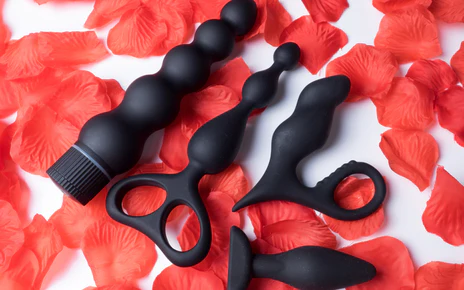
If you are arriving at this guide because you and your partner are considering trying it, the practical answer is: do not start with the strap-on. Start with a small anal training kit and work up over a fortnight or three. Prostate stimulation can be experienced fully with a £25 silicone training set; the strap-on is the next conversation, not the first.
For the strap-on itself when you do arrive there: a body-safe silicone strap-on dildo (no porous TPE), a harness that distributes weight well (the leather O-ring style or a panty-style harness, both work), and high-quality water-based lubricant. Silicone-on-silicone bonding (see our materials guide) means avoid silicone lubricant.
Our pegging starter guide covers gear selection in detail; this guide is the "what does it actually feel like" companion.
- What does pegging feel like for a man?
- For the receiving man, pegging typically feels like a deep, full pressure localised in the lower abdomen and pelvic floor, a sensation distinctly different from penile stimulation. With prostate contact, many men describe a slower, broader, more diffuse build than penile orgasm. A 2016 BJU International study found 71% of men report meaningfully different and often more intense orgasms with prostate stimulation.
- What does pegging feel like for a woman?
- For the giving woman, pegging is physically active, controlling depth, speed and angle of penetration. The harness creates steady indirect pressure on the pelvis with each thrust, which many women describe as quietly arousing. Many givers also report enjoying the role-reversal itself, separate from any specific physical sensation.
- Does pegging hurt?
- Pegging done correctly, with patience, sufficient anal-grade lubricant, a body-safe toy of appropriate size, and the receiver fully relaxed, should feel like a stretching pressure rather than pain. Pain is the signal to stop, add more lubricant, change pace, or use a smaller toy. Discomfort that persists is not "pushing through"; it is feedback.
- Does enjoying pegging mean a man is gay?
- No. Sexual orientation is determined by which gender of partner one is attracted to, not which sex acts one enjoys. A heterosexual man enjoying pegging from his female partner is being penetrated by a woman; the act does not change either partner's orientation. Multiple studies (Lehmiller 2018, Rye & Meaney 2007) have addressed this directly.
- How do you start pegging?
- The recommended starting point is not a strap-on but a small anal training kit over two to three weeks, allowing the receiving partner to learn the sensation and build comfort with relaxation. The strap-on enters the picture once the smaller toys feel routine, typically session three or four onwards.
- What is the prostate and where is it?
- The prostate is a walnut-sized gland located roughly 5–7 cm inside the rectum on the anterior (front, abdominal-side) wall of a man's body. It is densely innervated and is the source of the deep, distinct sensation associated with receptive anal play, sometimes called the "male G-spot" by analogy with female anatomy.
- Do men orgasm from pegging?
- Many men do, often hands-free, with prostate stimulation alone. The orgasm is documented in clinical literature as broader, slower-building, and longer than penile orgasm. Not every session ends in orgasm, particularly the first, and most couples report "the second time is significantly better" as both partners learn what works for them.
Sources & further reading
Prostate anatomy, sexual-health charity guidance, and consent context.
- NHS, Prostate problems and prostate health, NHS UK
- Prostate Cancer UK, Prostate information, Prostate Cancer UK
- Brook, Sex and pleasure, Brook Advisory
- NHS, Anal pain and prevention, NHS UK
Filed under Techniques
← Back to the Guides

